
Search Suwanee Voter Registration
The Georgia My Voter Page, usually called MVP, is the first stop for a person checking their own record. It asks for four identity details and returns a personalized result when they match. Choose Gwinnett County for a Suwanee registrant. This is not a browseable surname index or a public list of everyone registered at an address.
| Lookup input | Control | Required | How to enter it |
|---|---|---|---|
| First Initial | Text | Yes | Use the voter's first-name initial. |
| Last Name | Text | Yes | Enter the registered surname. |
| County | Dropdown | Yes | Select Gwinnett for a Suwanee record. |
| Date of Birth | Date | Yes | Used to verify the person, not shown as a public search key. |
| Submit / Login | Button | Yes | Opens the personal result when the fields match. |
A careful lookup uses the name as registered, checks the county choice, and submits the birth date. If no match appears, recheck those entries before contacting the registrar. The screen may then show status, polling place, precinct and district assignments, elected officials, a sample ballot, and absentee application or ballot status.
The identity form can be seen at the official My Voter Page source.
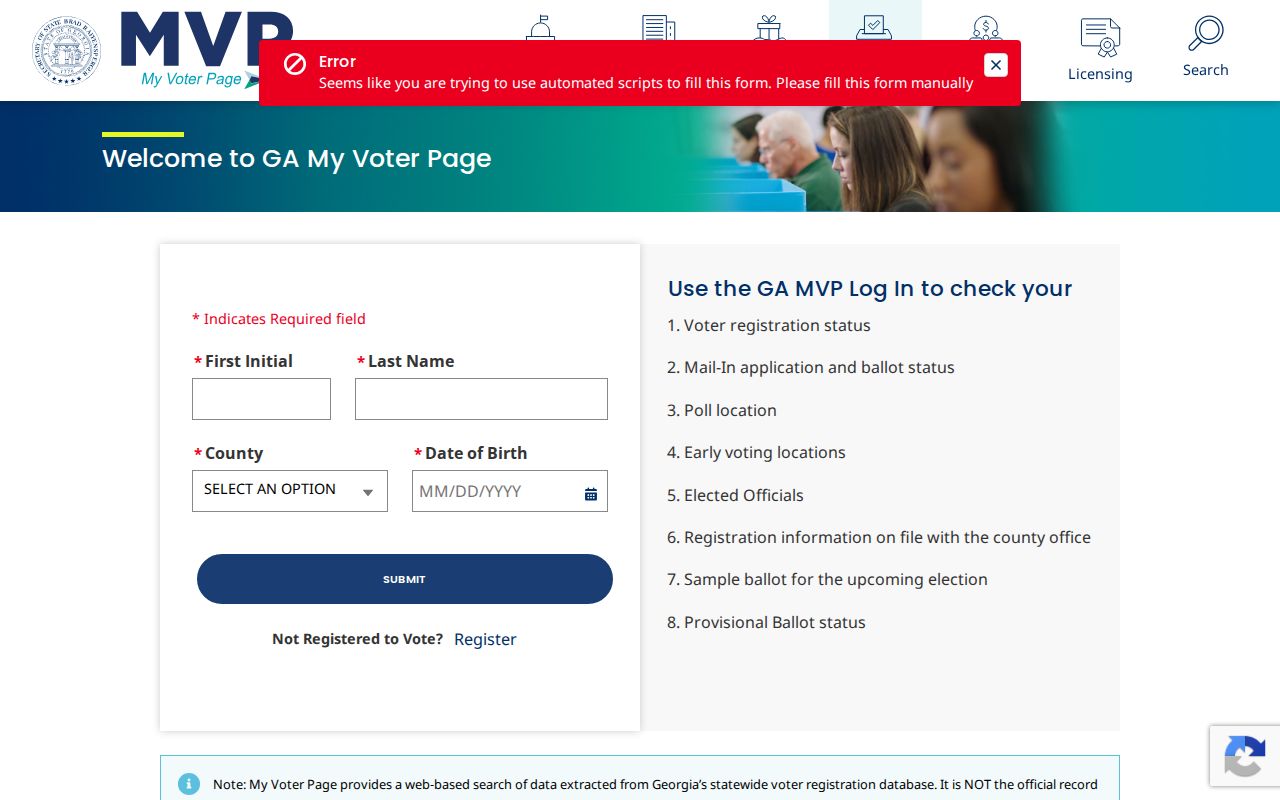
The captured form confirms that MVP requires personal details before it reveals the individualized voter record.
Suwanee Voter Lookup Results
MVP joins several current election facts in one result. Registration status answers whether the record is active in the state system. Polling and precinct details identify where that voter is assigned, while district fields connect the address to the offices on the ballot. Sample-ballot and absentee-status items change with the election cycle.
Participation history has a narrow meaning. It may show that an election was credited to the voter, but it cannot show which candidates or questions the person selected. Ballot choices stay secret. Georgia also does not register voters by political party. A field labeled “Last Party Voted” refers to the most recent primary ballot type selected, not party membership.
Note: A current MVP result is a personal status check, not a certified record or a historical voter index.
Fields in Suwanee Voter Records
The public file and the personal lookup are related, but they are not identical products. Georgia's ordered voter data may contain a name, birth year, registration number and status, registration dates, residence and mailing fields, precinct codes, district assignments, municipality, demographic fields supplied at registration, and election-participation credit. The statewide layout also carries status reason, last contact, last modified date, and record creation date.
| Identity | Last, first and middle name, suffix, voter number and birth year. |
|---|---|
| Address | Structured residence and mailing fields, unless an address is protected. |
| Political geography | County, precinct, municipality and congressional, legislative, school, council and other district codes. |
| Record dates | Registration, last modification, last contact and creation dates. |
| Participation | Election credit and primary ballot type, never marked ballot choices. |
| Status | Active or inactive status plus the listed status reason. |
Confidential by law. The released file excludes phone numbers, full birth dates, Social Security numbers, driver's-license numbers and protected addresses. O.C.G.A. §21-2-225 governs inspection and copies, while ballot selections remain secret.
Gwinnett Voter Records Office
Gwinnett County Voter Registrations and Elections is the local fallback when MVP does not match, an address needs correction, or a person seeks a specific county election record. The office handles registration changes, precinct information, absentee administration and county election material.
Voter Registrations and Elections
455 Grayson Highway, Suite 200
Lawrenceville, GA 30046
Phone: 678-226-7210
Fax: 678-226-7208
Email: VoterRegistration@GwinnettCounty.com
Normally weekdays, 8 a.m. to 5 p.m.
Ask for an existing administrative record, not an explanation the office must create. Give the voter's registered name, the relevant date or election, and the exact item sought. Confidential fields will still be withheld. General access-law procedure belongs with Suwanee public records access; election-specific identity and file rules remain with the election custodians.
Suwanee Voter Roll Geography
A Suwanee postal address does not prove that a home lies inside incorporated Suwanee. The city grew from about 3.1 square miles at incorporation to about 10.8 square miles, yet the postal community extends beyond those limits. This distinction can affect whether a voter belongs in a municipal file, even though the person still registers through Gwinnett County.
Use MVP's municipality and district assignments rather than relying on the city printed in a mailing address. The same caution applies when ordering a municipal precinct or municipality list from the state. A whole-county product covers Gwinnett more broadly, while a City of Suwanee order is narrower.
This split also guides a records request. A Suwanee municipal election item belongs with the custodian for that city election, while county registration administration belongs with Gwinnett Elections. A statewide voter file comes from the Georgia Secretary of State. State the jurisdiction in the request so staff do not have to infer it from a Suwanee mailing line. When a street falls outside incorporated Suwanee, use the district and municipality fields shown by MVP as the better routing evidence.
Order Georgia Voter Registration Files
The Secretary of State's voter-list ordering page provides bulk data separately from MVP. The order can cover a whole county, a municipality, districts, precincts, or the state. A Gwinnett County file costs $70, a municipality file costs $65, and the statewide file costs $485 under the schedule effective July 1, 2024. Other listed products range from county precinct groups to legislative and judicial districts.
- Choose the list type and whether it should include active voters only or active and inactive voters. Name the county and any municipality, district or precinct needed.
- Complete the purchaser name, physical billing address, email, contact person, phone, description, signature and payment details on the official order form. A post-office box cannot serve as the billing address.
- Prepay the Secretary of State by an accepted check, money order or credit card. Send the form to the Elections Division in Atlanta. Electronic delivery normally takes two weeks.
Standard local files arrive as CSV, a table-friendly text format. Statewide data arrives as text for import into spreadsheet or database software. The office does not offer custom orders, refunds or expedited service. The direct form also distinguishes a statewide file from the local list types.
Use limits apply. Commercial use of an elector list supplied under O.C.G.A. §21-2-225 is prohibited. O.C.G.A. §21-2-601 makes that misuse a misdemeanor, and no voter data should be used to threaten, stalk or harass anyone.
Protected Suwanee Voter Addresses
Georgia protects qualifying voters whose residence information could create a safety risk. The researched VoteSafe process can shield a qualifying voter's residence and records for four years unless the protection is withdrawn or cancelled. It uses supporting material such as a protective order or shelter documentation, and moving to a new county requires a new application.
The broader Safe at Home program supplies a substitute address and mail forwarding for eligible survivors of domestic violence, sexual assault, stalking or human trafficking. These related safeguards should not be treated as public directories. A protected address is left out of voter rolls, and a requester has no right to reconstruct or expose it.
The state routes elections, confidentiality programs and other public services through separate agencies. The official Georgia state organizations directory shows that agency-level route.
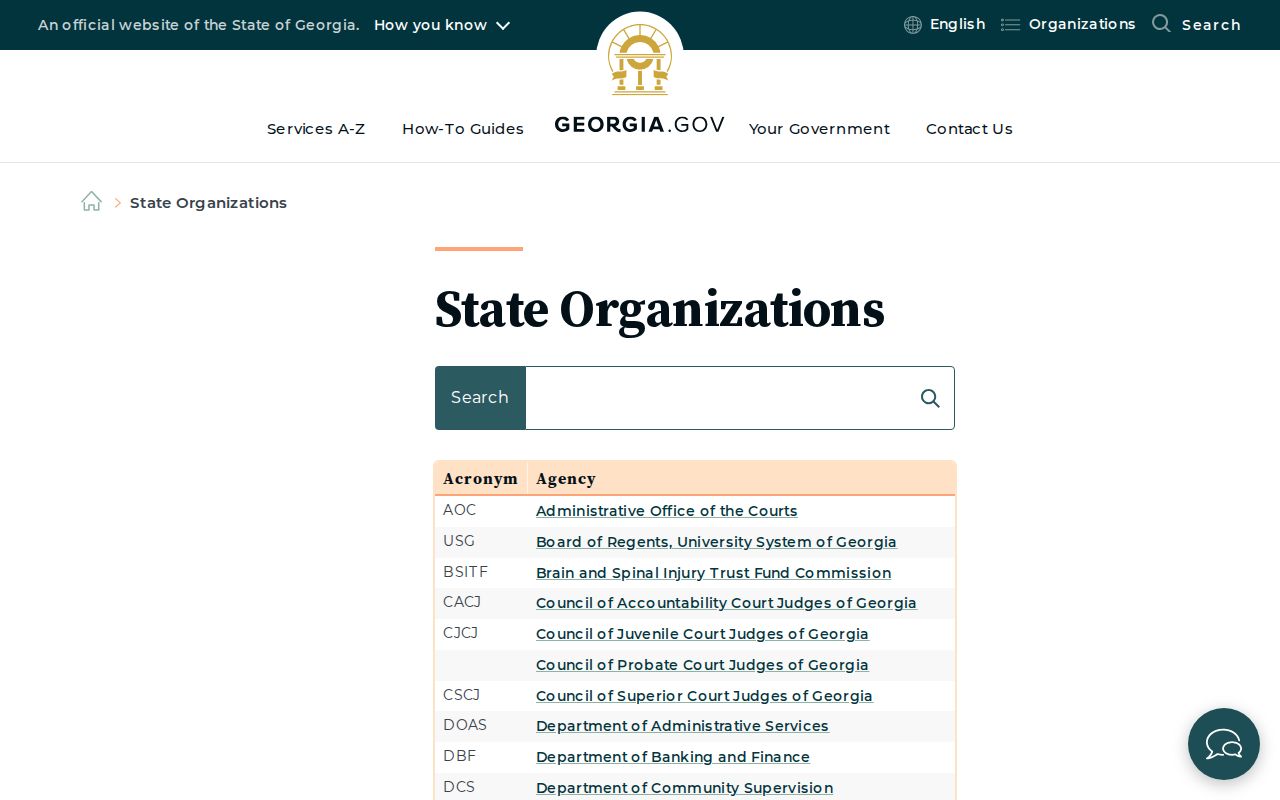
The captured state directory supports agency routing, while MVP and the Elections Division remain the direct sources for voter records.
Suwanee Voter Status Changes
Inactive does not mean immediately cancelled. Duplicate records, verified deaths, felony or incompetence records, and confirmed moves can lead to action. Address-confirmation mail and nonresponse may move a record to inactive status, but federal notice and timing rules prevent cancellation merely because someone did not vote.
The researched state process uses five full calendar years without contact, a confirmation process, continued voting eligibility while inactive, and two more even-year general elections before cancellation eligibility. A voter who sees an unexpected status should check MVP and contact Gwinnett's registrar to update the address or resolve the record. That direct check is more reliable than drawing a conclusion from an old list.
Note: Order active-and-inactive data only when status history matters, and read the status reason before interpreting a name on the file.
Historical Suwanee Voter Records
Current MVP data does not work as a historical voter index. Older poll books, registration registers, elector lists and returns require a different chain: ask the Gwinnett elections custodian about retained county material, search the Georgia Archives catalog and county records, then consult the Gwinnett Historical Society archives for original county books and related collections.
Retention schedules offer a guide, not proof that a specific Suwanee volume survives. County electors and marked-electors lists are kept for five years, while municipal authority lists are kept for two. State schedules mark certified county voter-registration-list files permanent, numbered lists for ten years, and election returns permanent. Exact Gwinnett poll-book years and Suwanee-level registration statistics were not verified, so researchers should ask by election date, jurisdiction and record type.
Historical participation records can place a person in a district at a point in time, but they still do not disclose a ballot choice. Pair a found name with another identifier before deciding that two records concern the same person.
Suwanee researchers should also separate a retention period from public online access. A permanent state file may still require a catalog request, and a short-lived local list may no longer exist after its approved retention term. Record the election date, list title, county or city, and any precinct number before contacting an archive. Those details give the custodian a defined series to check without assuming that every old Suwanee voter roll has been digitized.